Automation & Bots
Automation software: let software handle the repetitive work
Some teams copy the same data from one program to another every day, build reports by hand and track orders in spreadsheets. At Mofay we hand that work over to software: business process automation, production and stock tracking systems, integrations between systems and bots. Your team focuses on the work; the chores stay in the software.
What can be automated?
Any repetitive task that follows defined rules is a candidate. The ones we see most: reading e-invoices and delivery notes into accounting or stock software, work order and production tracking, low-stock alerts, daily and weekly reports generated and emailed automatically, and website leads routed to your CRM and the right person.
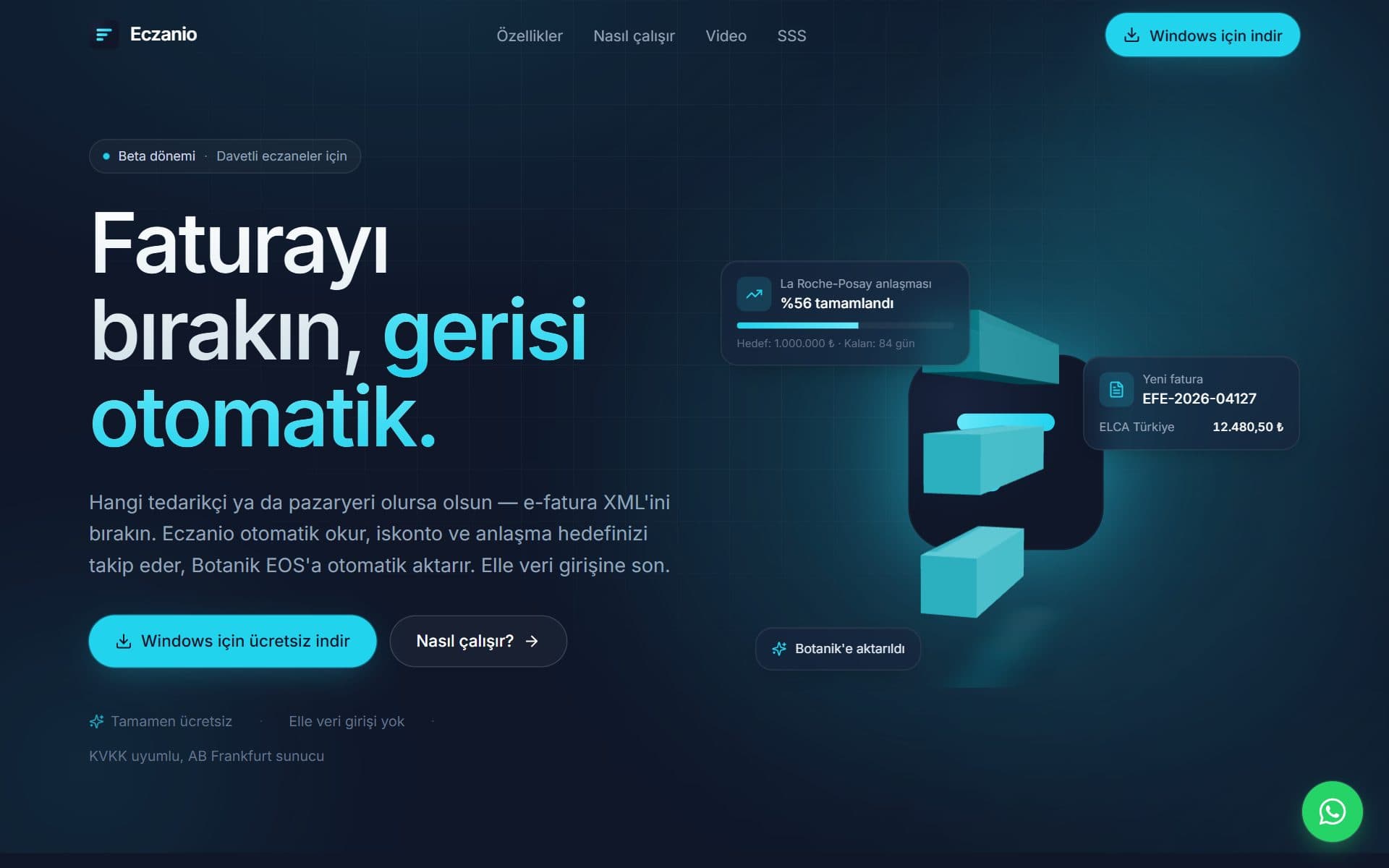
Our own product Eczanio is a concrete example: it reads pharmacies' e-invoice XML files, tracks discount and agreement targets, and transfers everything into the pharmacy software automatically. Hours of manual data entry become a single drag-and-drop.
Tracking systems for production and manufacturing
In manufacturing, work orders, stock and deadlines are often run through spreadsheets and phone calls. Which order is at which stage, and who produced how much, only comes together at the end of the day or month.
We build systems that bring these processes into a single dashboard: a work order is opened, progress is visible stage by stage, stock drops automatically as materials are used, and orders at risk of delay surface on their own. We integrate with your existing accounting or ERP software — no need to rip out what already works.
What we do
Robotic process automation
Manual clicking, copying and form filling handed over to rule-based software robots.
Production & stock tracking
Work orders, stages, materials and stock in one dashboard, with delays flagged before they happen.
Automated reporting
Flows that pull data from different sources and prepare and send daily, weekly or monthly reports on their own.
System integration
Accounting, e-commerce, shipping and CRM software connected through API bridges, so data is never entered twice.
Document & invoice processing
Solutions that read e-invoices, delivery notes and orders, check them and transfer them into the right program.
WhatsApp & Telegram bots
Chat bots for order status, appointments, notifications and internal team alerts.
How we work
- 01
Process analysis
We map how the work runs today, step by step: who does what, in which program, and how long it takes. Together we pick where automation pays off most.
- 02
Scope & proposal
We propose a first phase targeting the most time-consuming task for a fast return. Written proposal within 48 hours.
- 03
Build & test
We test the system with your real data and run it in parallel with the old method to make sure results are correct.
- 04
Rollout & training
We show your team how to use it and follow closely in the first weeks. 3 months of free support included.

Frequently asked questions
Do we need to replace our current software?
Usually not. We build automation that talks to your existing accounting, ERP or e-commerce software. If a change is needed, we tell you up front and explain why.
How long does automation software take?
An automation targeting a single process usually takes 2-4 weeks. Larger projects like a production tracking system are split into phases, with the first phase going live quickly.
Is our data safe?
Wherever possible we run systems on your own infrastructure or on servers in your account, designed with data protection in mind and access restricted by permissions.
Does automation make sense for a small business?
If there's a repetitive task taking a few hours a week, yes. What matters isn't company size but how often a task repeats and how long it takes. If the gain would be small, we'll say so.
Other services
Websites & E-Commerce
Corporate websites, e-commerce stores and landing pages built in İzmir, Turkey. Fast, search-friendly and flawless on mobile. Proposal within 48 hours.
View serviceMobile & Desktop Apps
iOS and Android app development, from design to App Store and Google Play launch, by one team. We have 6 apps live on the App Store.
View serviceAI Solutions
Chatbots trained on your own data, document and invoice analysis, AI-assisted customer support, and measurable AI integration into your existing software.
View serviceTell us your most time-consuming task
Which job eats your team's hours every day? Walk us through it and we'll give you a clear timeline and cost for automating it.